
top of page
  • Twitter
  • Instagram
  • Youtube
IMG_20201016_111734.jpg
Kansai and Beyond LOGO b+w big.png

Daily Life

Want to know what life in Japan is like? Read more about it here on my posts!

Teaching

Interested in working in Japan as an ALT? I've got you covered! Read more.

Travel

The exciting part of living in Japan is getting to travel through this beautiful country. 

Tips & Tricks

Other posts on food, art, culture, daily rambling, rants, etc etc...

Subscribe to Kansai & Beyond for updates!

Thanks for submitting!

Search

I was recently reminded of a part of Japanese teaching that makes every teacher - big or small, Japanese or no - want to run for the hills. A ex-coworker of mine had posted about this on her stories and it literally brought forth some tainted memories of my time in Japan.


Yes, it is worse than teaching Science when you cannot even Science yourself.


It is even worse than bringing all the kids on a field trip to god-knows-where Japan so they can run amok and tire themselves out.


That's right, there is something much worse.


Swimming.


Teaching elementary school kids swimming.


I would say most if not all private schools have a swimming unit as a part of gym classes. For public school, it varies. I've always worked at schools that didn't have this tacted on, as they often didn't have an on-site pool to go to. If any, they would need to go to a nearby community pool which is most likely already reserved for their older cousins in Junior High or the general public. Because private schools are ballers, there are often on-site pools and therefore - swimming must happen.


Now, let me first tell you why this is such nightmare fuel from the administrative side:


Pools in Japan are mostly outdoors. Mostly. Like 99% outdoors. That means any on campus pool is more than likely outdoors. I only know of one school who has an indoor pool at their school and even our students wanted to become students over there instead, just for the pool.


Look, maybe you're used to swimming in an outdoor pool. But... have you CLEANED one? More like, maintained one so the kids won't freak out of dead bugs and debris?


As a teacher, I basically had to volunteer my time on the days my grade has swimming lessons so clear out the bugs 30 minutes before my daily work time started. Yes, I know - this is probably a "this school just sucks for asking you to do that" thing and not really that bad of a task (like, if you'd ask me to scoop out bugs DURING my work hours, it would be acceptable). But still. Point is, there are these random tasks that as a teacher, you'd have to do for the good of the school that is truly BS.


We also need to decide what we need to teach and... teach them.


It doesn't matter if you can swim or not, this class is completely all hands on deck.


I happen to like water and swimming so it's not the end of the world, but if you had a fear of water...... well, you better get over it quickly. Or pretend you don't have one. Luckily, the pools don't have too much of a deep end at the school I taught at, so adults can stand on tippy toes even at the deepest. But remember, you aren't in this pool alone.


You have to make sure 30 kids in your class don't drown. Multiply that by the other classes you're sharing this pool with so you can just combine the classes together (have more eyes and less chances you'd actually have to teach). I don't know about you, but a normal swimming lesson in Canada dumps you into a pool with only 6-8 other kids. This is almost 3 or 4 times more kids.


And heck, there's no lifeguards on site. YOU are the lifeguard.


So not only are you trying to teach the kids SOMETHING - you need to make sure they don't drown nor fool around.


And if you're teaching the youngest grades, you'd hope they keep their fecal matters in and not end up in the pool......


Now, I don't know if you've ever tried to dress your kids after a day at the pool, but I hope you'll agree with me that it's a chore. Thankfully(?), we don't have shower rooms so we don't need to wait for 90+ kids to fully shower, but getting the kids to get themselves out of wet swimsuits is... a task. It usually takes upwards of 30 minutes each time to get the kids dressed, and another 30 minutes to round up the kids again so they can change back into uniforms. That's an hour lost.


And of course, you also have to get yourself dry and out of your wet clothes. But you also need to supervise the kids so they aren't fooling around while changing.


So if I had gotten anything out of this, I'd say I am probably a gold medalist for changing out of my swimsuit into dry clothes if there ever was an Olympic event.


I don't know a single teacher who enjoys teaching these lessons.


Hi friends, it's been awhile! I hope the weather's been treating you well. Now that I'm back in my hometown and properly away from Japan life in real time, I've been just slowly reflecting on life, enjoying and reconnecting with my family and friends. Least to say, a lot has happened since I have left Japan and all has been...... interesting.


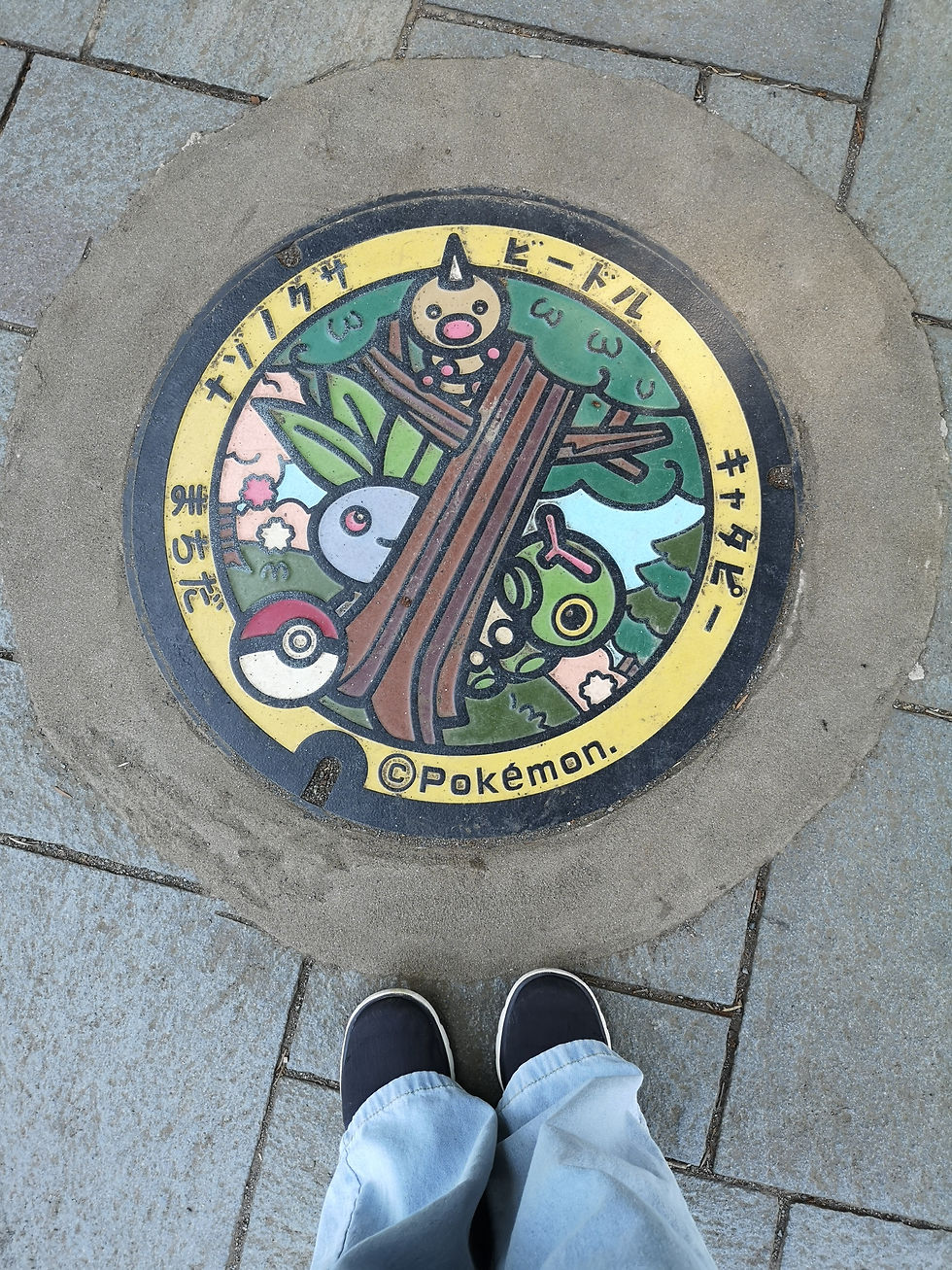
Anyway, I saw a post earlier this week on a Japan travel forum. Someone posted a few photos of Pokemon manholes they've found, stating they were properly surprised to find them.


And me, having gone around to so many of them...


...just kind of assumed they were common knowledge? I guess not!


So here we are today!


Way back, I actually wrote a blog about why you should go Pokemon manhole hunting, so check that out if you haven't already. To reiterate, these are GREAT ways to go out and see Japan - whether you like Pokemon now or no. Each region/city/prefecture has a set of their own of manholes and they are all different from one another. So if you're just a manhole enthusiast, this would be great for you too.


Some sets of manholes are a bit of a trek. Even if there are 4 or 5 of them in the city, there may not be easily accessible train or bus access, and what may be just a 10 minute drive each between manholes may end up being a full day hiking affair.


But Tokyo area has three pretty accessible sets of manholes.


Realistically, you can do this in a day if you do nothing but see these manholes - but I do highly recommend setting two separate days for them (in conjunction to say, spending the rest of the day in Shibuya or going to Teamlab first thing in the morning before trekking out) so you can enjoy some of the local attractions too. And you really need daylight to see these as they're not lit up or anything which means you only have about 10-12 hours to travel between locations, eat and walk around.


1) Machida City


The first set of Pokemon manholes are in Machida City inside of Serigaya Park.


While it's not the easiest to get to, there are six of them in total in this park, which means you can knock six of them all in one go! It took me about an hour to walk through this park to get all six of them. It is a pretty sizeable park and the summer heat can slow you down as it did with me, so do keep that in mind as you are hunting.


If you are staying in Tokyo, you will be taking the Odakyu private rail to get here.


From Yokohama, it's a straight shoot from the JR line to Machida Station.


It's about a 10 minute walk from the station and you should hit your first lid not too long after that. If you follow google maps to the park, the first lid you will hit is the Bulbasaur one - but I won't be posting these in order. You can click on the link under each photo to the official Pokelid website. They all have VERY accurate pinpoints of these lids and recommend using them as your guide!


Not a Pokelid lol, but I do want to point out that the park is very kid-friendly and I did see a lot of kids just enjoying this water feature and just running around, playing sports. So if you need an off day while travelling with kids, this would be a great place to do it.


Please use the pinpoints on the official website! They are 99% of the time very accurate, unless you have a delayed GPS. I personally didn't hang around the park for too long, but of all my Pokelid hunts, this one was definitely the most chill. No worrying about trains, connection times, driving, etc. Great way to get them steps in and enjoy Pokemon!


Other Attractions Along the Way...


If you're using the Odakyu line from Tokyo, chances are you will pass through Shimo-Kitazawa and Noborito Station.


These stations are relevant if you like Totoro and Doraemon respectively.


The original "Totoro Cream Puff" store is located at a local non-express station called Setagaya-Daita Station. If you're doing this trek in the morning, this might be an ideal pit-stop for a yummy cream puff or two. But go early since they do sell out by afternoon most of the time:


Shiro-Hige’s Cream Puff Factory

5 Chome-3-1 Daita, Setagaya City, Tokyo 155-0033, Japan


If you're a Doraemon fan, you want to stop in at the "Fujiko F. Fujio Doraemon Museum" which has direct bus access from Noborito Station. You will need to make a reservation to get inside, so I recommend doing this in the morning so you don't feel rushed to get back and make your reservation.


Fujiko.f.fujio Doraemon museum

2 Chome-8-1 Nagao, Tama Ward, Kawasaki, Kanagawa 214-0023, Japan


Personally, I did find the Doraemon Museum to be a bit expensive for what you're able to do and see, which isn't a lot... but the museum is sort of made for art/manga lovers and kids in mind. So if you enjoy looking at original manga sketches, learn about the history and have kids, the museum will be an absolute hoot for you.


I did think it was worth it in the end, since you can create your own Doraemon stamp with your name on it for 1000 yen a pop. A great souvenir and unique to the museum :)


I hope this was helpful to someone. In Part 2, I will cover another two sets of lids so stay tuned for that!


When I jump onto Japan travel help forums, I often see people saying they want to go to an "onsen" (or a hot spring) during their travels.


what we generally think of "onsen"

The request sounds simple enough. I mean, the media and all the beautiful travel guides & influencers make it out to be like onsens are littered EVERYWHERE in Japan... is it not?


It's actually really not that simple.


Especially when the travellers want "onsen" recommendations in big cities like Tokyo, Osaka and Kyoto.


First of all, you must understand that there are guidelines to follow in order for a bath or the water to be considered an "onsen". In order to qualify as an onsen, the water MUST naturally have one of these 19 minerals of a certain quantity:


19 minerals that can exist in order to be considered an onsen

The water must be over 25C and be approved by the Japanese Onsen Law. So as you can see, it is a regulated affair. Does that mean big cities don't have water quality like this? I'm not saying that, but to be fair - it will be quite hard to hit a natural vein in such a high density area that wouldn't be dried up or contaminated in some way over the centuries. So realistically, meeting the request of going to an "onsen" might be a bit of a trick question for most residents trying to help a tourist out.


However, not all is lost.


Just because there may not be natural veins of mineral water, doesn't mean that there aren't baths.


That's where a "sento" comes into play.


What is a Sento?

Bathing culture is huge in Japan, so naturally, demands must be met.


These days, it's common for households to have their own baths and most locals will draw their own baths for daily use. But in big cities like Tokyo, there are still some tiny dwellings that might not have their own bathroom. Share Houses are common also amongst younger people, maybe as their first taste of freedom, where they might have to share one bathroom with many housemates.


Simply put, public bathhouses (or "sento") has become a solution to these modern problems.


And public bathhouses are simply just that. Bathhouses.


Bunka Yokusen (https://www.bunkayokusen1010.com/)

They serve the community at large that needs a place to freshen up, where they otherwise wouldn't. Kind of like an airport shower facilities for travelers. They're simple, and they get the job done. They aren't meant to be touristy, but like many things in Japan that exists - if it exists, there is most certainly a fanbase. And there many enthusiasts who find the charm in documenting bathhouses. In fact, some of these bathhouses have historical significance and may be worth a visit for some people.


Definitely check them out if you're interested, or may find yourself in need of one during your stay.


So now, what about "super sento"? Where do they come in?


Super Sento - The Bathing Amusement Park

It's in the name really. It's a sento, but "super(-sized)".


Super sentos are community solutions of a local hangout, a family event or simply just places for friends who want a day of relaxation to go. It's kind of like going to the movie theater to have fun, but instead you're getting naked in a bath with people you know.


And what makes a super sento "super", exactly?


Other than just simple bath facilities, these are full on spa-like giant complexes.


In Osaka, good example of a popular "super sento" is Spa World:


I'm not the biggest fan of Spa World...

As you can see, this isn't just the baths (onsen) - they have sauna, swimming and even accommodations. While not in the picture nor advertises, they will often advertise spa treatments like massages, facials and other esthetic treatments geared for women.


The biggest difference with "sento" and "super sento" is that there are a lot of varieties of bathes in a "super sento".


Some iconic selling points may be that they will have a "flavoured bath" that changes every month. A good example of such baths is the famous Yunessun in Hakone and their wine baths. Super Sento will offer one of two of these flavours, along with other varieties like carbonated baths, outdoor baths, hard flat-beds with shallow water, waterfalls, etc etc. You will not find these creative baths in a sento.


Another popular tourist "Super Sento" is Solaniwa Onsen in Osaka:


And Nobeha No Yu (also in Osaka):


These places have a rather large co-ed area where you can wear clothes provided by the establishment to walk around, read some manga, enjoy some food at an extra cost and even have arcades game you can play.


Ok, but why are these Sento still called themselves "onsen"?

You have noticed that some Super Sento also call themselves "onsen". That's probably because there may be one or two baths in the sento that have onsen properties to them. For example, in Solaniwa, there is a bath that they claim have minerals amount that fit the list to be considered an onsen.


Whether you and I believe that is another question entirely...


And I think this is why the concept of super sento and onsen are pretty blurred. Very often these supposed onsen in the cities are actually really "super sento", but they have the word "onsen" in the name. So long story short, if the quote-on-quote "onsen" you are going to has all the frills and conveniences of a recreational complex - it's probably a SUPER SENTO.


Not that there's anything wrong with a super sento.


They can be super fun, and the variety of baths in these super sento can give you a better give you a better money's worth of experiences. Of course though, the idea of a super sento is to trap you in the facility for as long as possible so you would spend extra money, so there is that to consider. But they are great alternative way to experience the bathing culture in Japan, and a good way to test and see if you might be comfortable getting fully naked in a bath or not. After all, if you aren't comfortable, you can just get dressed again and spend your time in areas of the super sento that don't require being naked. They can also be found in almost every city and every tourist hub too.


I hope this clears up the confusion a little bit.


Let us know in the comments or in our social media accounts if you have any questions!


© 2019-2021 by Kansai & Beyond

bottom of page