
- Kansai & Beyond

- Mar 5, 2021
- 11 min read
(all images used in this post are stock images from Unsplash. If you have an issue with the photo, please contact them for removal!)
I'm back again to talk shop today. And today I'll be covering Junior High School (Grades 7-9) part of this so-called experience series.
If you missed it, I talked about elementary school in part one:
And, part 3 will be about: High School (Grades 10-12)
I will link them as I complete writing about each one. So please look out for them!
Junior High School (JHS) is actually the bulk of my experience here in Japan. I've taught at various JHS all throughout Osaka, mostly. So my experience wouldn't be so diverse as someone who's worked all over Japan. And I've actually taught at schools where some of them are considered "pretty bad" - so you may find students who are more motivated and have a completely different experience.
However, I have experienced teaching solo in a Japanese classroom and team teaching. So I want to start off talking about this first before I get into the students! But first, some main differences from elementary school.
Differences from ES

Classes are 50 minutes instead of 45 minutes. In elementary school, most classes are set at 45 minutes so the day ends slight earlier. In JHS, classes are mostly 50 minutes unless there are important things that need to be done - like Sport Day Prep, or sometimes a school assembly. These will be announced ahead of time, and reminded of on the day during morning staff meeting.
You will be teaching all the grades and classes at your JHS one a week. You’ll be scheduled down to teach them, but in some cases, the JTE might not need you to be in the classroom if you’re - for example - just returning a test back to the students that day. Talk to your JTE and see if there’s plans to reschedule.
All JTE are supposed to be able to speak English. Most of them should be able to hold a simple conversation, or at least discuss lesson plans with you. Their actual speaking ability will vary, but I often find that even if they don’t have great speaking skills, their reading skills are pretty good. So use a pen and paper to communicate lesson plan ideas if need be, and give your weaker JTEs some time to process your plans.
You may be involved in making listening tests. The teachers may ask you to help them record a dialogue, so it can be used for the term tests. In some cases, they may even ask you to help mark tests - but usually only huge writing chunks that doesn’t involve any Japanese.
I’ve only been asked to mark maybe once or twice? But for some ALTs, this might be more of a norm.
A lot of JHS may not have a lunch program like they do in ES. Some may still do, and in that case, you will be asked if you want to join it. But often times, students start bringing their own bentos. At one school I was at, there was no lunch program, but every morning a “lunch lady” would come to the school would take orders from students (and staff) who need a bento that day. The lunch lady would show up before lunch to distribute the boxes to the students who made a purchase that day.
In the case of staff where there’s no lunch program in place, the teachers may group order bento from nearby restaurants. At the same school where they had no lunch program, there’s a sign up sheet at the head teacher’s desk with menus/flyers of local restaurants. You write your name, the item you want, how much it costs and drop your money into a box.
The admin staff will place the orders around 1st period of class, and the orders will be delivered before lunch. They’re usually around 400 to 500 yen sets, unless you want sushi - which is always a bit more expensive. There was a bit of an unspoken rule where you only order sushi if someone else in the staff room orders it too, as it’s a bit more of a luxury and teachers don’t really want to stand out I guess? Sometimes it becomes a full on debate whether it’s sushi day or not, and convincing other teachers to change their order to join them. Haha. All in good fun, of course. No pressure at all.
If there are convenience stores nearby, some teachers may opt to hop out, grab convenience store food during lunch time and hop back in. As an ALT though, you are often told you need permission to leave school grounds. But in my experience, it’s less about permission and more about just telling the Vice Principal you’re stepping out to buy lunch. Or pretty much any errand that’s close by that you need to do. I often would go to the post office during lunch since it was just across the street from one of my schools. I’ve never been told no.
At a private school, there will probably be a cafeteria that’s staffed by a catering company. That way, students and staff can buy lunch as they please.
Solo vs Team Teaching
For those who have the know-how in the ALT world, I just want to say that it's actually "not illegal" for uncertified ALTs to teach solo in a JHS classroom. The same cannot be said in high school though, which I will talk about this more in a different blog. I say "not illegal" loosely as technically, an ALT shouldn't be in the classroom without a JTE... but at the JHS level, if a ALT were to teach solo, these classes are usually graded
in combination with a class that a JTE is teaching 3-4 a week separately on her own. So in that sense, schools can get away doing this at the JHS level.
Most schools just opt not to do this as I suspect the curriculum is too tight, and JTEs often find they already don’t have enough class periods to spare to cover all the material they need to by early JHS 3rd year. Essentially from that time onwards, it’s exam crunch time in preparation for high school - even less time for teachers to cover material.
However, at private junior high schools where students often feed into their high school counterpart, there’s a bit of a leeway for more optional conversation courses. So at these schools, you may be more likely to find a solo ALT.
Of course, this can exist in a public school as well.
Let’s talk more about team teaching first as this is way more common.

There’s a few different settings you might find yourself in:
1) Complete free-reign of 50 minutes
2) Free Reign of one activity (part of the lesson)
3) Tape Recorder
Some teachers will ask for a combination of these kinds of roles you’ll take. In my experience though, if you’re stuck as a tape recorder from the start, you’re often tape recorder for life at that school... sometimes that’s just the way the JTE wants it, and you can’t change it. Other times the JTE just doesn’t have much time to explore other ways to give the lesson, and it’s up to you to convince that JTE otherwise (which can backfire). But yeah...
Oh, and by “tape recorder” if you didn’t know this already, is when you are given a textbook and your role is simply to read the passages and get students to repeat after you. That’s your only role.
Having been to several JHS in my time here, I’ve only been stuck as tape recorder a handful of times. I’ll talk about it more as we talk more specifically about each grade.
Now.. Solo teaching, for me, was extremely free.
I did this for one year before it was outsourced to a dispatch company. Having no actual training for this, it was a bit daunting at first. The biggest two struggles were really to plan a coherent curriculum out of nothing, and not having a Japanese person to rely on to explain more complex terms in Japanese.
Since I was solo teaching, I didn’t need to use the normal curriculum textbook. The JTE was already covering that on their own. I could do extra activities following the units of the textbook, but not doing this meant I didn’t need to flag the JTE down every week and keep asking if she’s finished page so and so (then subsequently figure out if I can do the activity, so on and so forth).
So instead, we did our own things.
One of the things I really enjoyed doing solo teaching is I can plan more activities that span more than one class. Like an easy research project, or other kinds of group projects that you can slowly build up throughout the semester.
With team teaching, you always have to mind what the JTE is doing. So the activities don’t usually last more than one class. And then you’ll have to make a new activity to practice a new grammar point or a different skill, for example. And often times you can’t know ahead of time what those grammar points are, so you can’t plan ahead and tie them all together.
The Classes & Students
First Year JHS
This group has always been somewhat of a mixed bag for me. At some schools, these students are the rowdiest as they are the youngest and the most carefree compared to their seniors. At the same time, because they are the youngest - some schools have a batch where they are the most obedient. They know their place, so to speak.
I think it comes down to the school dynamic. In a school where there is a hierarchy with seniors, and your seniors are actually decent students, they will follow suit. If your senior students act up, chances are the young ones will copy and do the same.
For team teaching, I’ve mostly been asked to cover 50 minutes with some kind of activity. Some teachers will be more specific and tell me:
“We are doing page x, which is y grammar - can you think of a game for students to practice using these sentences?”
Sometimes, the teachers just have no idea. In which case I just bounce a few games around that are common in Japanese, and can be reworked with English vocabulary. Stuff like karuta (a card game).


These are actual karuta card sets that students can cut out from one the textbooks and keep. They’re super handy and makes for easy review of verbs & vocab - and you can add modifications to the karuta game to make it more difficult.
Most the first semester is focused on getting students comfortable with reading and writing English. This means JTEs have to teach the alphabet, cursive writing (I hear that’s no longer taught?), and just sentence structure in general. This often means that the textbooks really go back to the basics like self-introductions, but more in depth. Nowadays I hear that (some?) elementary schools cover alphabets, and some writing. So perhaps there’s a bit less time spent on that.
The rest of the year is mostly covering pronouns, present tense structures, interrogative sentences, continuous form and simple past.
This will vary depending on the textbook used at the school.
Most teachers will also drill verbs and verb forms as part of vocabulary building. I’ve also worked with JTEs who tried to drill some adjectives, but not as common since it’s not really part of the textbook.

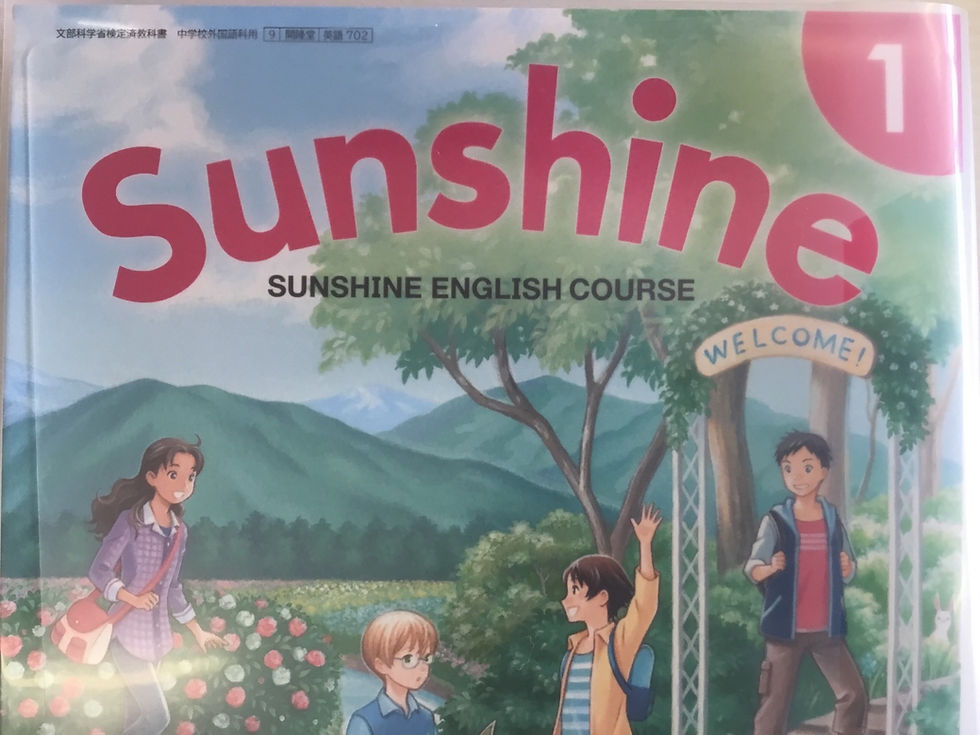
The above photos are just two textbooks I’ve used in the past. There’s other plenty of other ones, and it’s sort of up to your BOE or your school to decide which one they will use.

These are a few other titles. New Horizon is another popular one that a lot of schools use. As you can see in the picture, the books come in sets of 3. One for each grade in JHS. It’s pretty standard for schools to choose just one title and stick to it, but publishers will often visit the schools to give them samples of other books just in case they want to switch. And the switch would be made throughout the whole school.
It’s pretty rare for public schools to change titles once they‘ve stuck onto one, but it’s not uncommon for teachers to have copies of other books.
The contents are pretty similar throughout. The style its presented, stories and characters they use will obviously be different... but generally will still cover whatever the MEXT curriculum
2nd Year Students

In my JHS experience, I don’t think I’ve ever taught an angelic class of 2nd year students. They are by far, some of the most carefree and mischievous bunch I’ve ever taught.
If your experience with the 1st Year was bad, them transitioning into 2nd Year will often mean that they might get worse... or they might get calmer, but just be a lot smarter on how not to get caught (but still maintain the same level of bad).
You should be able to gauge which direction this will go in a smaller school a month or two before the end of the school year... in a bigger school where it's common for students to not stay in the same class, it's much more of a mixed bag.
At this point, a lot of friend groups & cliques are more or less established so the loud students get louder with their group of friends and vice versa. If those loud friends end up in the same class, then you're definitely in for a treat. If they get split, they'll probably still find a way to get on your nerves and you wouldn't be able to do anything about it.
JHS in general is just a highly, hormonal bunch.
But at this level, students have a bit more English in their toolbox and you can pull off some longer skits and even start doing some paragraph-writing. In my experience, this is the level where there's a ton of skits about shopping or asking for directions. Just your sort of tourist-guidebook type of English.

The above photo are just materials I’ve made in the past. Can’t believe I still have them!
It was a lesson on shopping for tshirts - learning how to say different sizes, colours, how to ask for different style, etc.
3rd Year Students

JHS 3rd year is usually high school exam crunch time.
Some JTE at this level may tell you just not to come to the classes because most of the lessons will be having students do practice tests or practice questions. And they don't need any ALT to help them with that. So if a JTE cancels a lesson at this grade, definitely don't take offense to it.
Students are generally better than the other two grades that I've ever taught.
Some will continue to monkey around since hormones are still flying all over the place, but a lot of them will really crunch down once it's closer to the end of the year to get into high school.
High school is optional education, but those who choose to go will have to take entrance exams to get in. The better the school, the more competitive and "harder" the test. Which means students who are serious will have to really crunch down for those tests.
I thoroughly enjoy teaching this grade overall.
At this point, they should be able to produce simple sentences somewhat easily. And even if they can't, they are able to listen to your English a bit more than their juniors. It makes talking to them in English a little bit easier. A few of them may be more motivated to try a bit more to speak to you as well.
General Thoughts
JHS will probably be one of the more difficult levels you will teach if you're not used to cheeky teenagers with attitude. If you're better with small kids, this will probably be a little bit difficult too.
Of course, it really depends on the school you're put in. If you're in a generally good JHS, the students will also be much more well behaved and motivated to learn. On the flip side, if you're put in a more difficult school you'll have to deal with more difficult students. Likewise, the teacher and the staff will be less motivated... and perhaps don't have the energy to motivate their students to take up English seriously.
And in this case, your role as an ALT might not be to teach - your role might just be to talk with the students outside of classes, and be the adult figure they feel comfortable with.
In more extreme cases, you may even be met with some violence. I've known some ALTs who worked in the same city as me... where police presence at the school is a daily occurrence. Windows get broken, a teacher gets hurt from stopping fights, etc. They usually try not to send ladies into schools like these, I hear. But as ALTs we don't really get to choose whether we will get these situations or not.
I hope these blogs help aspiring teachers understand a bit more how it's like to be an ALT here in Japan. That's it from me today. I hope to see you guys on my next post!