
top of page
  • Twitter
  • Instagram
  • Youtube
IMG_20201016_111734.jpg
Kansai and Beyond LOGO b+w big.png

Daily Life

Want to know what life in Japan is like? Read more about it here on my posts!

Teaching

Interested in working in Japan as an ALT? I've got you covered! Read more.

Travel

The exciting part of living in Japan is getting to travel through this beautiful country. 

Tips & Tricks

Other posts on food, art, culture, daily rambling, rants, etc etc...

Subscribe to Kansai & Beyond for updates!

Thanks for submitting!

Search

Hi everyone! Happy new year!


Just before the new year, I went to Korea for the second time in my life. It’s so close to Japan you’d think I’ve gone there more, but I always prioritized Japan Travel over anything, which I hope to share more with you guys about over the course of this year.


Anyway, every time I go to Korea, it’s always to visit my friends. My friends left to teach in Korea the same time I had left to do my time in Japan, so it’s really nice to know you have someone there to go to when you travel. And of course, it’s nice to have them tell you certain practices and customs you wouldn’t otherwise think about!


This isn’t by any means a full list, but here are some things I learned that might help you in Korea!


A lot of restaurants only have 2-people servings

This one is a big one for solo travelers like myself, and like to visit local restaurants to try different foods. You may be surprised upon entering that the prices are quite high and the pictures for the food to have extremely huge portions. Well, congratulations, you might have just walked into a restaurant that only sell portions and sets starting from 2 people. Even if you’re by yourself, they do not have a size for one.


Which is great if you have a big stomach, but if you’re trying to eat all the things in Korea, it might be difficult for your stomach and your wallet.


Solution? Visit a street food market for your meals instead! There are so many different areas in Seoul that sell very delicious Korean street food for really cheap.


Another solution would be to go to the areas with a huge student population like Ewha Women’s University or Hongdae, as a lot of restaurant in those areas are geared towards students who want a quick, hearty meal before they have to jump right back into studying again.


Currently, We Fancy on YouTube is doing a series on solo dining, which I highly recommend if you’re looking for a solo sit down meal!


Throw Your Used Toilet Paper in the Bin!

I think this practice is becoming less and less common in tourist areas of Seoul, but it is still fairly common to have to throw your toilet paper in the huge trash bins next to your toilet bowl, not inside the toilet bowl.


I was told by my friends this during my first trip, which I’m glad they did, since it’s obviously not something I have to think about when I’m in Japan. The last thing I want is to clog the toilets and leave my business for everyone to see. Ewww!


Thankfully, I think a lot of tourist areas tell you to actually throw your toilet paper in the bowl (there are signs in English), and all the hotels I stayed at seem to be ok with toilet paper in the bowl, so I didn’t experience this much. But if there was no sign or if there’s a sign in Korean, but there’s a huge trash bin, I just dump it in the trash bin. Better be safe than sorry!


Little to No Plastic Bags

This seems to be a trend worldwide now, so it’s not so much of a shock. However as a resident of Japan who is still rather slow to roll this initiative out, it’s easy to forget. In Japan, the default is that they will give you a bag unless you place a sign in your basket saying you don’t want a bag.


In Korea, they will ask you in Korean if you want a bag.


Which means if you’re anything like me and don’t understand a lick of Korean, you might end up in a situation where the store clerk will hand you your merchandise without a bag, and then you have to use Engrish to explain to them you need a bag... (awkwardddddd)


The simple situation to that is really, to bring your own resuseable bag EVERYWHERE. But yeah. I’m clearly not that environmentally friendly yet... (and to my defensive, I need the supermarket plastic bags in Japan to sort my garbage)


Korea is (more or less) moving Toward a Cashless Society

I know this seems like a weird thing to learn, especially since the world is already moving towards cashless, but if you’ve lived in Japan long enough, you’ll understand that we’re still very much a Cash-based society. Of course in big cities, there are more and more stores that are moving towards net pay options, and the option to pay in card is there, but there are still a lot of things you need physical cash for.


As a tourist in Korea, the physical cash option is obviously available, but I noticed while traveling with my friend that she was using a Cashless option everywhere. It was just so quick and easy, and everywhere accepted it.


That’s when she told me that there are a few Starbucks in Korea that don’t even accept cash. Imagine that being implemented in Japan! That would blow everyone’s mind.

Have you guys been to Korea?


What are some practices and customs that are different in Korea than the one you’re living in?


Lately, I’ve been trying to actually get the ball rolling on the Japanese studies. I learned most of my Japanese by osmosis, really. So I thought it would be a good idea to go back to the basics and really hunker down on the grammar.


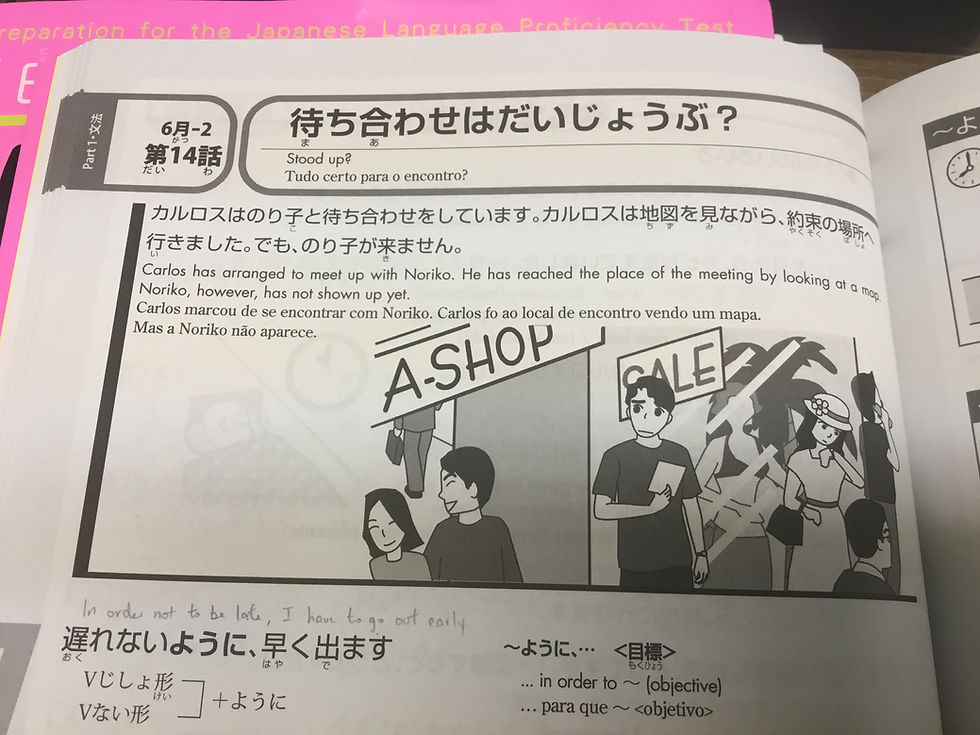
This is the book I’ve been studying with:


Let me tell you, this book has been a joyride. If my French textbooks in Canada were half as interesting, I would probably be pretty fluent too.


But seriously. In the textbook, there’s this dude (translation: sexpat) Carlos who’s new in Japan and it follows his life (and a few other characters) whilst he’s trying to learn Japanese and adapt to the country.


So far, all I know is Carlos is into futsal and he seems to be gunning for this girl Noriko like a true foreigner in Japan.

(This kid is a bit of a tool if you ask me)


Except the first time, he gets stood up.


And in a all-too-relatable scene further into the textbook, we see Carlos at it again shooting his shot.


“The First Date”


EXCEPT IT WASN’T (according to Noriko)


“Noriko just thinks of Carlos as a friend.”


WELP.


I’m completely invested in the Carlos’ love story now. This is a much better story than Singapore Social.


Stay tuned for further developments.


All-You-Can-Eat (or “Viking”, as they call it in Japan) is almost just as popular as it is in any other country. Who doesn’t like (a fair amount of) choice, and a free flow of food?


The first thing people would try to look for is AYCE sushi. Because why wouldn’t you? It’s Japan. It’s famous for sushi, and AYCE sushi is totally a thing. But AYCE sushi is not all that common in Japan, and if it is available, it is on the pricier side of the AYCE scale. But you don’t necessarily need to go to AYCE sushi - there are a lot of great 100 yen rotating sushi shops out there to satisfy your needs!


And since you’re in Japan, why not try some other types of Japanese food? Let’s talk about some other AYCE options here. Here are some options that won’t break your wallet:


Shabu Sai

(not actual picture from shabu sai)

Shabu Sai is a shabu shabu, sukiyaki and (kind of) a sushi restaurant all in one that offers 90-minute AYCE options. It’s mainly a shabu shabu restaurant, so your main option is shabu shabu, but you can opt to have sukiyaki sauce in your pot instead of soup and have AYCE sushi added on the side (just don’t expect quality sushi).


For their premium shabu shabu course for just a bit over 2000 yen, you have a choice of 2 pork types and 2 beef types (you can order as much as you like), plus a vegetable bar with a decent selection of vegetables and noodles. You have a choice of 2 soups shared between your group. Drink bar and alcohol are an additional cost.


You can also add the option of AYCE sushi on top of your shabu shabu course.


Gyukaku

(not actual footage from gyukaku either)

Personally, Gyukaku for me is still on the expensive side with courses starting at about 3000 yen, but it’s one of the cheaper AYCE yakiniku options in the country for the quality (which is really not that bad at all). There are cheaper options, but I personally think those restaurants have very poor quality meat, try to rip you off by giving you a starting platter of assorted meats you don’t necessarily eat (then charging you extra for the unfinished food - which you didn’t order) or just extremely bad service.


Most Gyukaku stores allow you to order with an iPad, so the process is usually quite fast and painless. The selection varies depending on what AYCE course you choose; the more premium cuts and usually things like beef tongue will be more expensive. You can also order a la carte at Gyukaku if you don’t think your party can do the AYCE course.


They have a good side dish selection as well, ranging from soups, pickled veggies and of course the carbs if you need some rice to go with your meats.


I also notice that while there are Gyukaku restaurants in other western countries like Canada, Gyukaku there is not AYCE - so I do highly recommend you try it out.


Kushiya Monogatari


I love Kushiya Monogatari, and so do all my friends I take with me to the restaurant. This restaurant is a kushikatsu (battered skewers?) AYCE, and the fun part is that you get to make the food yourself. While it can be a bit dangerous for young kids since there is a pot of scorching hot oil in the middle of the table, I think it’s a great experience for older kids and I think they might enjoy rolling the skewers in the batter and frying it themselves.


The price of this AYCE is about 2000-3000 yen per person (depending on location), with a 70 to 90-minute time limit. I believe you can pay more for more time, or at least they used to have this option - I’m not sure if that still exists.


They have a range of things you can fry - beef, pork, chicken, mushrooms, bell peppers, takoyaki (yep!), taiyaki and sometimes some seasonal limited time selections. Some stores even have a good selection of rice and noodle dishes, and of course, desserts.

There are a ton of other AYCE restaurants in Kansai and all throughout Japan, but if you are in Kansai and you’re traveling on a smaller budget, I highly recommend the above restaurants.


There are also some hotel buffets in the range of 2000-4000 yen; which isn’t necessarily cheap, but it is cheaper than other buffets of slightly better quality. Those buffets are also usually a good mix of foods from different countries, which is not what this list is about.


I hope that helped some people!


Please keep in mind that most if not all AYCE here in Japan have a time limit.


© 2019-2021 by Kansai & Beyond

bottom of page